.svg)
.svg)
The name Common Space emerged from a period when I was thinking deeply about how design operates beyond the surface of objects. Like many designers, I began my education focused on form: typography, composition, image systems, the careful calibration of visual language. These tools remain central to the discipline, but over time I became increasingly interested in the structures surrounding them.
The question that lingered was simple enough: what actually makes culture possible? What allows artists, audiences, institutions, and ideas to encounter one another in the first place? The answer, more often than not, is some form of shared environment. Sometimes it is physical, sometimes digital, sometimes social, but the common denominator is that culture requires a space where interactions can occur.
My design thesis, titled Musical Notation for Describing Space, began as an attempt to understand this idea through the lens of sound. I was fascinated by cymatics and sacred geometry, the mathematical patterns that appear when vibration interacts with matter. These systems suggested that different media might share deeper structural principles. Sound, architecture, image, and movement were not isolated phenomena but variations on a common set of spatial relationships.
At first I believed I might be able to translate techno music into visual notation through these geometric systems. In retrospect, that ambition was charmingly misguided. Music did not require my translation. What the project ultimately revealed, however, was something more useful: that the underlying patterns shaping different media often resemble one another more than our professional categories would suggest.
This realization gradually shifted how I approached design. Instead of seeing design primarily as a tool for producing images, I began to see it as a method for shaping environments. A website becomes an environment where information unfolds. An exhibition becomes an environment where ideas encounter one another. A gathering becomes an environment where relationships form.
The phrase common space captured this idea succinctly. It described a condition in which multiple perspectives, disciplines, and communities could intersect without collapsing into uniformity. The goal was not to erase differences but to create the structural conditions under which those differences could become productive.
Through my studio, Common Space, I try to design these environments intentionally. Sometimes this takes the form of digital platforms that allow artists to organize their work in ways that remain accessible to future audiences. Sometimes it involves helping institutions rethink how their archives and exhibitions relate to one another. Other times it means creating physical gatherings or collaborative structures where people can meet outside their usual professional roles.
The interesting thing about common spaces is that they rarely appear neutral. Every platform, every archive, every institution carries assumptions about who belongs and how knowledge should circulate. Designing a common space therefore involves more than simply inviting participation. It requires examining the invisible rules that structure participation in the first place.
In the art world, these rules are often inherited rather than consciously designed. Institutions reproduce formats that worked in the past without asking whether those formats still serve the present. The result can be environments that feel strangely disconnected from the cultural realities they claim to represent.
Common Space, as a studio, attempts to intervene at precisely this level. Instead of treating design as an ornamental layer applied after decisions have already been made, the studio engages earlier in the process. We ask questions about the architecture of the platform itself. How does information move? Who has access? What relationships does the system encourage or discourage?
These questions are not always comfortable for institutions, but they are increasingly necessary. Cultural platforms today operate in a world shaped by global networks, digital archives, and rapidly evolving technologies. Systems designed for the slower rhythms of the twentieth century often struggle to keep pace with those conditions.
At the same time, the goal is not simply to modernize institutions through technological upgrades. Technology alone rarely solves structural problems. What matters more is whether the underlying framework of a platform allows it to adapt and grow. In other words, whether the space truly functions as a common space.
One of the more surprising things I have learned through this work is that artists often understand this dynamic intuitively. Many artists already operate as platform builders. They organize exhibitions, publish books, host gatherings, and create networks that extend beyond the boundaries of their individual work. What they sometimes lack is the infrastructural support that would allow these platforms to sustain themselves over time.
Common Space exists partly to fill that gap. It treats design not simply as a visual discipline but as a strategic practice concerned with how cultural environments are built and maintained. If the studio has a philosophy, it is that culture flourishes when the spaces supporting it are designed with care.
The name, in that sense, is less a brand than a description of an ongoing project. A common space is not something one creates once and finishes. It is something one continually maintains, adjusts, and reimagines as the communities inhabiting it evolve.
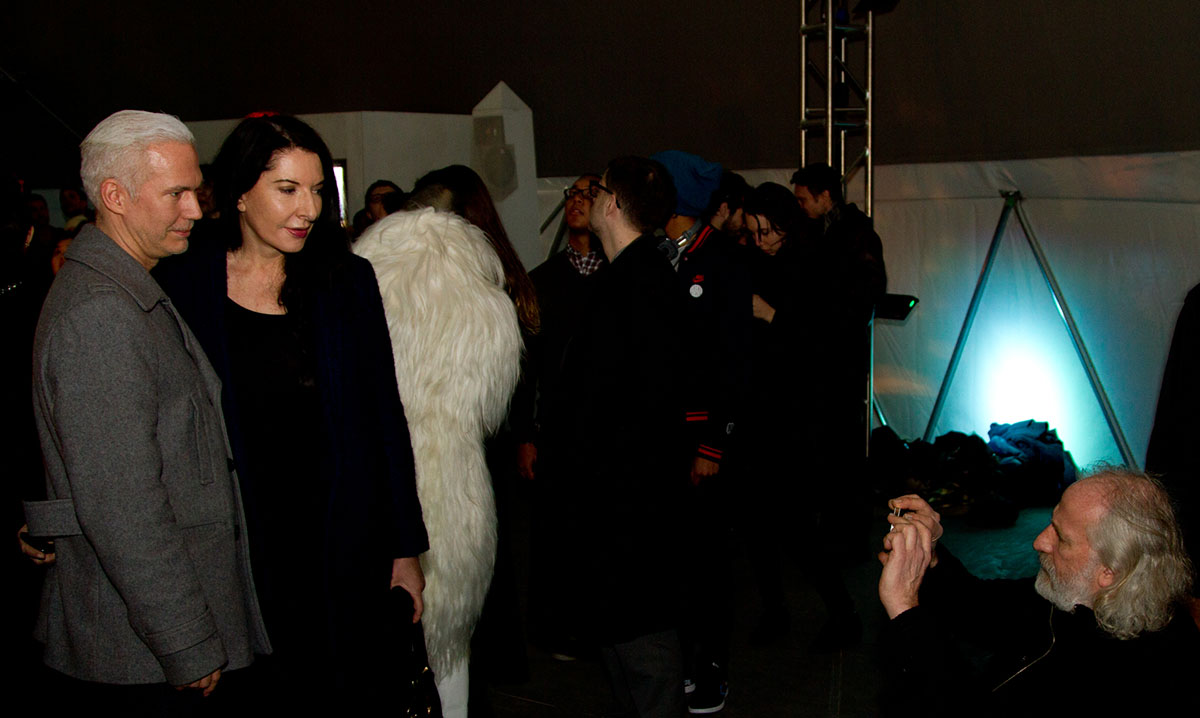
Photo: "Rave Labor" Hosted by Josh Kline and Jon Santos. The MoMA PS1 Performance Dome becomes a multipurpose, pop-up work party, February 19 2012.